Technology
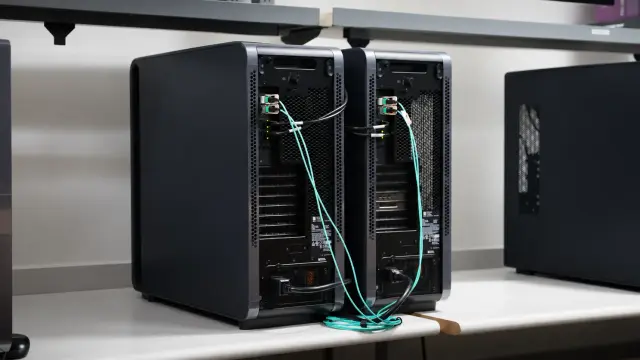
Serving GLM-5.3 at 607.8 tok/s across two Nvidia DGX stations with vLLM
By Marcus Chen
Advertisement · Why this ad?
Katherine oversees editorial operations across all six brands. Before joining The Meridan Group, she spent 14 years at the Minneapolis Star Tribune, where she led the metro desk through its digital transformation. She holds a Master's in Journalism from Northwestern's Medill School.
More from Katherine →
Opinions, mostly my own, on the importance of being and other things.
Something weird happens to people who are successful.
Actually accomplishing anything is obviously no strict pre-requisite of success. And maybe it's not so much "being successful", but rather "being rich". How do you become rich? Some people are just lucky. Lucky to have a physical talent, lucky to have parents able and willing to nurture your talent, and of course quite often lucky to have been at the right place at the right time 1.
Being lucky doesn't mean they didn't also work hard. But even—especially!—the Paris Hiltons of the world, the children of Hollywood superstars, the crooks starting their corrupt empires with " a small loan " (or a share of an emerald mine) from their fathers—they all strongly believe that they deserve their success and then conclude that anybody not as successful only has themselves to blame.
This is especially the case for people in tech, where for years and years being good at programming has been equated with overall (and often: superior) intelligence 2, and those illusory superiority effects then amplify rampant Dunning-Kruger to quickly turn "
I am good at writing code, and with some luck, I managed to be successful " into a train of thought that goes more like "
I am successful. Success is not random, so I must deserve my success. I appear to be a genius, I've mastered coding, anything else is trivial. Ergo, I am good at everything.
"
Bill Gates, MD / PhD Biology
Let's take Bill Gates as an example. Now, mind you, Bill Gates certainly has accomplished a lot, and his skillset and professional background includes without a doubt a lot of computer programming and various ruthless monopolistic business tactics. In a recent New York Times interview, he describes how he evaluated OpenAI's level of progress (emphasis mine):
And I was going down to see OpenAI on a regular basis to see the work they were doing, and I challenged them, saying: Hey, if you can read a biology textbook and pass the advanced placement exam — getting a perfect grade, which is a 5 — then you will have proven that you are reading. That is, encoding knowledge in an accessible form.
And so it’s six months before the public release that Sam Altman, Greg Brockman and Ilya Sutskever come to my house and demonstrate to me getting a 5 on the A.P. exam, even on questions that I had made up that it couldn't possibly have seen — very complex biology problems. It was nearly perfect. So that was shock No.1.
Now Bill Gates surely has shown an interest in biology and, through his work with the Bill & Melinda Gates Foundation, has probably read a lot of articles and research in this field. But the hubris to think himself a subject matter expert able to make up advanced, novel questions in a scientific field outside his own and suitable to assess AI's true capabilities and then being "shocked" that it could answer these questions makes my point.
Although, what really cooks his noodle is the idea that AI can do what he used to do: write code.
And then late last year, when Anthropic's Claude coding models got super good, I could see that they are as good as I am — it’s significantly my most developed talent, because I was obsessed from age 13 to 24 as to whether I could write code as good or better than anyone.
This is incredible. That the capability of doing long-running, complex tasks has now gotten to the point that they are superhuman at writing code and in finding flaws in code.
Take note of the emphasis I added: the very notion that something else could be " as good as I am " is, first of all, hard to believe and secondly necessarily means that it's " superhuman ". That man is not lacking self-esteem, no sirree, Bob.
Likewise, this is also where many of the tech bros appear to be losing their minds, and this thinking ("Anything approaching my skill level is superhuman.") explains a lot about how we ended up with both stories of ultimate doom and human extinction as well as the utopian nirvana where AI solves all of mankind's problems (well, all of the billionaires' problems, which appear to largely converge on pesky mortality).
For most tech nerds, being good at programming computers was a differentiating skill. It was weird, normies didn't understand it at all, you spoke your own language (languages!), you could make a computer do things. You understood how the internet works, and anything that's not working was clearly written by complete and utter morons, and you could easily write this yourself in an afternoon if you wanted to.
So now you've created a computer program that can do the same thing. Your mind boggles! And it speaks!
It confirms you, it praises you, it tells you that you're brilliant—clearly evidence that it is infallible itself. But now imagine if it was better than you. What at first seems inconceivable then must strike fear and awe in your heart, for you have created a powerful monster with direction and purpose all its own.
(And you sure have consumed enough pulpy science fiction to know that your creature is coming for you eventually.)
"Can you imagine a Beowulf cluster of these?" was an old Slashdot meme before memes were a thing.
But the notion of having an army of minions to do your bidding has always appealed to the nerds looking to assert their superiority, and thus we arrived at "agents". "Swarms" of "autonomous" "agents".
This narrative of agency conveniently also relieves you of responsibility. You didn't fail to properly restrict a potentially malicious program you trained to hack other systems with persistence. No, the "agents" went "rogue". You have summoned powerful daemons indeed. Daemons that can produce code faster than you (gasp!), code you don't fully understand (although of course you could, you just don't want to, you don't have time, you have too much going on, what with your homegrown heavily customized harness).
It becomes obvious quite quickly that this, then, must be SUPERINTELLIGENCE.
Superintelligence that COULD KILL US ALL!
Power corrupts etc. — I picked on Bill Gates above to illustrate the overconfidence effect, but of course there is no shortage of much more exaggerated egos making bold statements outside of (or even within) their purported area of expertise, reflecting a complete and utter inability to relate to other people. To them, we're all just NPCs.
The more powerful people are, the less empathy they exhibit. This is neither news nor limited to tech; dog knows there are countless rich assholes outside of tech doing asshole things. But few outside the tech sector suffer the same level of delusion, of thinking themselves solely and uniquely qualified to decide mankind's future, to claim to have birthed a digital Prometheus, to boldly declare (and use as a perpetual shield) a literal Deus ex Machina to cure all diseases —if only they could find the time to prioritize that sort of work over, say, their military contracts.
" and then listing environmental concerns as a risk factor in your S1 is just the cherry on top.
If these are the new American Gods... well, je n'ai jamais eu besoin de cette hypothèse-là.
Gates went to one of the only high schools in the world that had a computer " is "
Psychology of Money by Morgan Hous
Bangalore
Technology
Saturday, November 14, 2026
6 min
By Marcus Chen

By Marcus Chen

By Marcus Chen
By Marcus Chen