Business
Sonia recalls Maneka's stormy 'Choti Bahu' years
By Marcus Chen
Advertisement · Why this ad?
Marcus manages the day-to-day editorial workflow across all brands, coordinating coverage assignments and ensuring editorial standards are met. He previously served as city editor at the Pioneer Press and holds a degree in Political Science from Carleton College.
More from Marcus →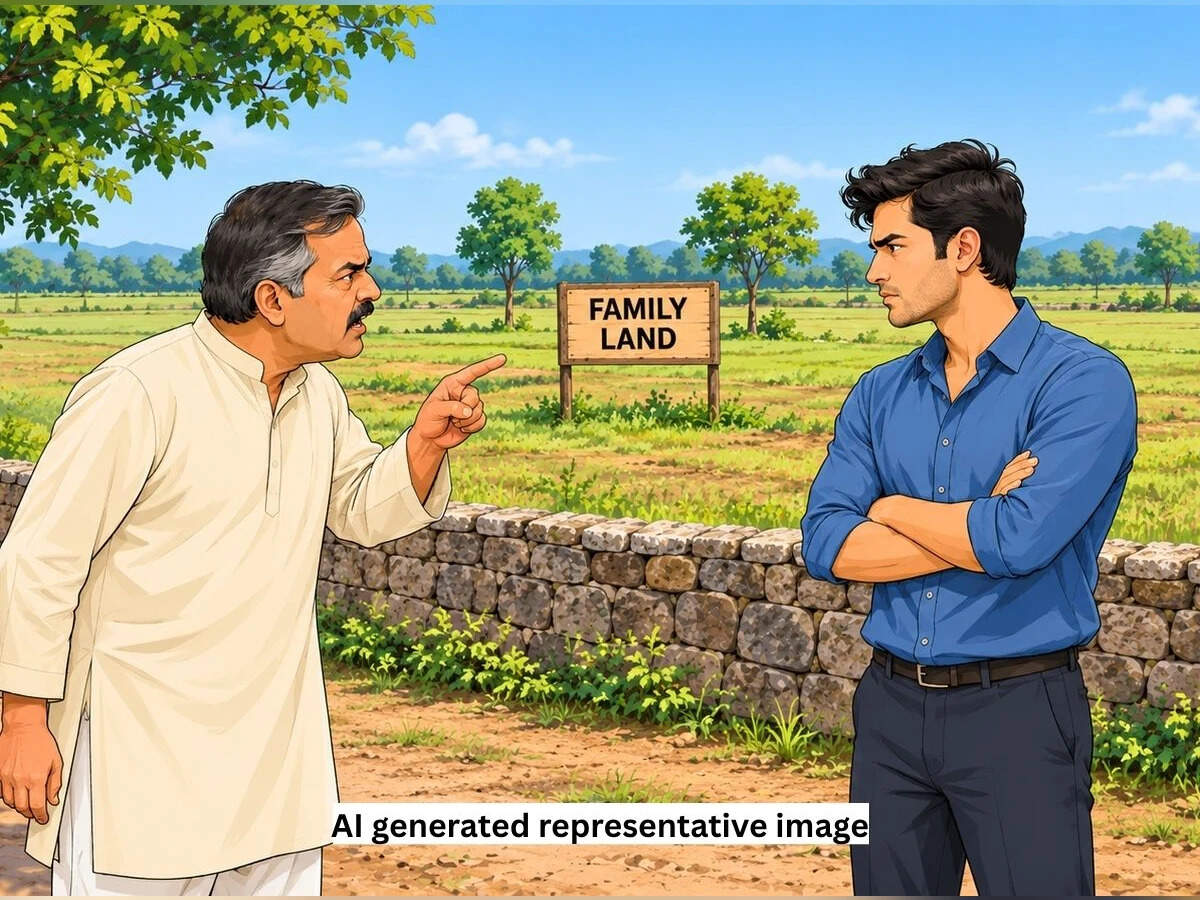
Synopsis A recent Madras High Court case addressed the inheritance dispute between two brothers regarding family property. Balakrishnan challenged their father's decision to gift land to his younger brother Jayachandran. The court upheld the validity of prior partition arrangements and gift deeds while reaffirming Balakrishnan's rightful share of the separate land. Balakrishnan was ultimately granted a 1/8th share in his father's self-acquired property. Listen to this article in summarized format Listen ET Online A recent Madras High Court case shows that when you own significant assets and a large family, it is wise to divide it among your children while you are alive. This prevents unnecessary fights between your children after you’re gone as they compete for your share. This particular case involves two brothers, Balakrishnan and Jayachandran, fighting over family property. Balakrishan claimed that their father gave Jayachandran more land through both a gift deed and a Will, while he and his other siblings received less. What is the dispute about? Let’s look at the facts. There were four pieces of land in Melapalayam. Three lands, one Grama Natham land, were given to Mr Pachamutu Pillai during a family partition in 1970 and he bought one land measuring 3 acres and 3 cents. So, Pachamutu Pillai owned three small lands, a Grama Natham land and a 3-acre-3- cent big land parcel. Now, Mr Pachamutu Pillai had seven children of which four were boys; Balakrishnan, Jayachandran, Sukumaran and Selvam. Pachamuthu orally divided the land in 1984 among himself and his four sons. The 3-acre 3-cent property and the Grama Natham land were not part of this partition. A Koor Chit was later prepared on May 22, 1984, to record this oral partition. Under this oral partition, Pachamuthu and Jayachandran each received about ¾ cent, while Sukumaran and Selvam received about 391 sq ft each. Balakrishnan received about 360 sq ft along with a pathway. Jayachandran later built a house on the portion allotted to him. Also read: Daughter took father’s land by paying Rs 7.25 lakh in cash to her brothers and abandoned father, he filed a court case; Karnataka HC gives back the land to him However, on May 29, 2000, Pachamuthu Pillai executed a Gift Settlement Deed , transferring his share of the land to Jayachandran. On July 24, 2000, he executed a Will leaving the Grama Natham land to Jayachandran as well. So in totality, Jayachandran got more land: His own 3/4 cents (given under Koor chit) Father’s 3/4 cents (given under gift settlement deed) Grama Natham land measuring 382.5 sq ft (given under father’s Will) Balakrishnan was unhappy with Jayachandran receiving their father’s share of the land and decided to challenge it in court. He argued that his father, Pachamuthu Pillai, had no right to give the lands to Jayachandran because they were joint family lands and could not be dealt with as his individual property. Jayachandran and their other brother, however, disputed this. They told the court that these lands are covered by the 1984 oral partition where the lands were already divided among the family members. To support his story, Jayachandran relied on the Koor Chit prepared after the oral partition and said that the partition had taken place in the presence of village panchayatdars. Jayachandran also argued that the Will had been properly executed and proved according to law. In Jayachandran’s case, three portions were relevant: the share he received in the 1984 partition, the additional share later given to him under the 2000 Gift Settlement Deed, and the 382.5 sq ft of Grama Natham land covered by father’s Will. So, the dispute before the court essentially concerned the validity of the 1984 oral partition, the 2000 Gift Settlement Deed, the Will covering the Grama Natham land and the separate 3-acre-3-cent property. Also read: Family members can reject sale of joint HUF land and treat it as void if Karta sells it solely for personal benefit; Key legal rules you must know 1984 partition valid, says Madras High Court In its judgment dated September 18, 2026, the Madras High Court held that the 1984 partition was valid and that the properties covered by that partition could not be reopened. It also upheld the Gift Settlement Deed in favour of Jayachandran and the Will covering the Grama Natham land. However, the Madras High Court also ruled that Balakrishnan was entitled to a 1/8 share in the separate 3-acre-3-cent land belonging to his father. Why did Balakrishnan lose the case challenging his father's 1984 oral partition (Koor Chit) and the 2000 Will? Navod Prasannan, Partner at King Stubb & Kasiva, said to ET Wealth Online : Balakrishnan's challenge was largely unsuccessful because the Court found that the family properties had already been divided between his father and four sons in 1984. The written document, known as the Koor Chit, was prepared after the oral partition to record an arrangement that the family had already agreed upon. The Court observed that the document was supported by witnesses and reflected a substantially equal division of the properties. Although Balakrishnan disputed his signature, he did not take the necessary steps to prove that it was forged. The Court also considered the fact that the arrangement was challenged after approximately 16 years. An important aspect of the judgment is that once a family property is validly divided, each person's allotted share becomes their separate property. Therefore, Pachamuthu was within his rights to gift his share to his second son, Jayachandran, in 2000. Similarly, the Court upheld the Will relating to the Grama Natham land, as it was established to be Pachamuthu's separate property. The Will was supported by witness testimony, and the Court found no sufficient reason to doubt its authenticity. However, it is important to clarify that Balakrishnan did not lose the case entirely. The Court recognised his right to an equal share in the agricultural land independently purchased by his father. Accordingly, he was entitled to 1/8 of that property, along with the other seven heirs. What should families dealing with inherited properties do? Prasannan says that this Madras High Court judgement highlights that an oral division of inherited family property can be legally recognised if there is sufficient evidence that the family agreed to it and acted upon it, but it is advisable to properly document such oral division. According to Prasannan, once a family property has been divided, each of the member has the decide how to dispose their allotted share and memebers may also gift it to another family member. The member also has the freedom to decide who inherits this particular property and may also execute a Will regarding this. Prasannan also says that this case shows the importance of understanding the difference between a previously divided family property and self-acquired independently purchased property. The inheritance rights between both the types of property are quite different. For example: A son has no right in father's self-acquired property but may have right in inherited property. Also read: Not all family properties are ancestral: Son has no birthright in father’s self-acquired assets Madras High Court discussion Justice R. Sakthivel heard this case. No definite answer whether Pavadai Pillai died before or after Hindu Succession Act, 1956 The Madras High Court explained that if Pavadai Pillai (the grand father) died before the commencement of the Hindu Succession Act, 1956, then property inherited from him would be ancestral property in the hands of his heirs (Balakrishnan, Jayachandran and others) However, if Pavadai Pillai died after the commencement of the Hindu Succession Act, 1956, then properties inherited from him would be separate properties in the hands of his children (legal heirs). The Madras High Court cited the Supreme Court cases of Arshno