
Business
Microsoft suffers outage after dethroning Nvidia
By Katherine Langford
Advertisement · Why this ad?
Katherine oversees editorial operations across all six brands. Before joining The Meridan Group, she spent 14 years at the Minneapolis Star Tribune, where she led the metro desk through its digital transformation. She holds a Master's in Journalism from Northwestern's Medill School.
More from Katherine →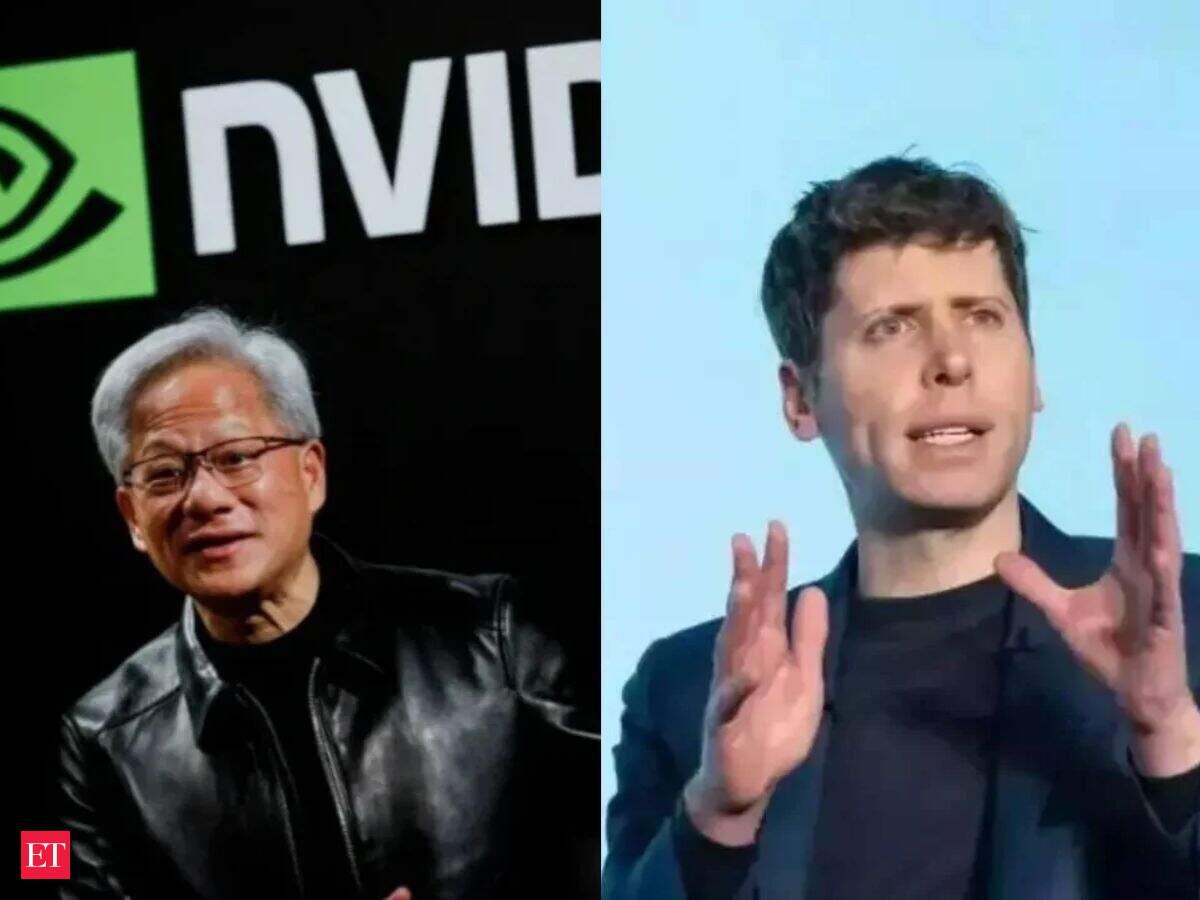
ET Online Jensen Huang 's departure from Nvidia has triggered an unusual backlash, with employees and some of Silicon Valley 's most influential figures questioning the decision and calling for his return. The calls are not merely about loyalty to a founder but reflect concerns about what his exit could mean for a company that has become central to America's AI ambitions as China closes in on the technology race. More than five decades after arriving in America as a child, Huang has built one of the country's most strategically important technology businesses. However, his departure may not be irreversible, unlike what happened to Sam Altman at OpenAI in 2023. ALSO READ | The Taylor Swift of Tech: Jensen Huang's mastermind rise, wildest dreams and the anti-hero fall Employees want their boss back The most significant sign of discontent has emerged from within Nvidia itself. WIRED has reported that an internal suggestion-box post urging the board to consider employee sentiment about Huang had attracted more than 1,600 comments. A majority reportedly supported bringing him back. Live Events The post was submitted by a longtime engineer before Huang's resignation. Several employees subsequently urged the board to reconsider its decision. One anonymous commenter wrote, "If you believe in the mission, bring back THE boss." Another acknowledged that people make mistakes but argued that Huang deserved a second chance. ALSO READ | Nvidia scandal puts China chip curbs back in focus as US lawmakers push tougher export restrictions The support has extended beyond the internal forum. Around two dozen Nvidia employees posted messages backing Huang on LinkedIn. One employee also sent a companywide email seeking transparency about the investigation into his departure. "I stand by Jensen," the employee wrote, adding that America should not fail someone who helped build its technological future. These are not necessarily indications of a companywide revolt. The 1,600 comments were responses to an internal post, not 1,600 signatures on a formal reinstatement petition. But the strength of the sentiment presents a challenge for the board. Silicon Valley's influential voices join in The reaction has been equally striking outside Nvidia. Several prominent technology entrepreneurs and investors have used X to express their support. Elon Musk responded "That would be an honor" to a post asking him to hire Huang. He also endorsed a post by Sequoia Capital partner Shaun Maguire, who argued that Huang's contribution to America's AI leadership could not be overstated. Epic Games founder Tim Sweeney described on X removing Huang as being comparable to Apple firing Steve Jobs. He credited the Nvidia founder with driving successive technological shifts, from gaming graphics to CUDA and AI supercomputers. Anduril founder Palmer Luckey wrote: "China wants Jensen out, so I want him in." Former Binance chief Changpeng Zhao called Nvidia's decision a mistake. Former Twitter CEO Dick Costolo went further, predicting on X that Nvidia could eventually bring Huang back if the company began missing earnings expectations. Perplexity chief executive Aravind Srinivas also praised Huang's 33 years of leadership. These endorsements do not amount to a coordinated campaign to reinstate him. But they show that concern about his departure extends well beyond Nvidia's workforce. Jensen Huang built something greater than a chip company Understanding the reaction requires looking at what Huang actually built. Nvidia is often described as the world's leading AI chipmaker but that description understates its position in the industry. Huang turned Nvidia into the centre of an interconnected computing ecosystem. Its GPUs provide the processing power needed to train and run large AI models. But the company also supplies the networking technology, software and computing systems that allow thousands of these processors to work together. CUDA, Nvidia's software platform introduced in 2006, allowed developers to use GPUs for general-purpose computing. Over time, researchers and AI laboratories built software and workflows around it. This created a formidable ecosystem advantage. A customer considering an alternative chip does not simply compare processing speeds. It must also consider software compatibility, developer expertise and the cost of shifting established systems. Huang also understood that Nvidia's future depended on coordinating an increasingly complex supply chain. Its advanced processors rely on manufacturing partners such as Taiwan Semiconductor Manufacturing Company and suppliers of high-bandwidth memory. The company must coordinate with data-centre operators, networking equipment makers and cloud providers to ensure that its products can be deployed at scale. At the other end of this chain are customers such as Microsoft , Amazon, Google and specialised cloud providers including CoreWeave. AI laboratories such as OpenAI, Anthropic and Meta depend on access to large amounts of computing capacity. Huang's achievement was to bring these different parts together. Nvidia did not merely sell chips to customers but also worked with cloud providers to build computing infrastructure, supported developers building AI applications and invested in companies that could expand demand for its technology. This coordination itself became a competitive advantage. A rival could develop a powerful processor, but replicating the relationships and infrastructure surrounding Nvidia would be much harder. Why his exit matters to America's AI ambitions Huang was Nvidia's chief strategist, dealmaker and political advocate, as an AP report described him. His departure has raised questions about whether the company can maintain its leadership and whether uncertainty could affect the wider AI investment boom. Nvidia's relationships with customers, governments and technology partners have been built over decades. Huang was central to developing many of them. He also played an important role in Washington's debate over semiconductor exports to China, repeatedly arguing that American companies should remain competitive in the Chinese market rather than surrender it to domestic rivals. His departure could complicate existing negotiations and investment commitments. Nvidia has invested in several AI companies that also buy its chips. Such arrangements have attracted scrutiny because the company's investments can help finance demand for its own products. A change in leadership could prompt partners to reassess some of these relationships. Huawei and other Chinese chipmakers are working to reduce their dependence on American technology. Any uncertainty at Nvidia could create an opening for competitors, although it would be wrong to assume that Huang's exit automatically transfers Nvidia's technological advantage to China. The larger risk is a loss of continuity at a time when American companies are spending enormous sums to build AI infrastructure. Nvidia's products remain difficult to replace, but its ability to coordinate the wider ecosystem has been a major part of America's advantage. The Sam Altman precedent The possibility of a comeback is not without precedent. In November 2023, OpenAI's board abruptly removed Sam Altman as CEO. The decision triggered an extraordinary employee backlash . More than 700 of the company's roughly 770 employees signed a letter demanding that the board resign and Altman be reinstated. They threatened to leave for Microsoft if their demands were not met. Within days, OpenAI reached an agreement for Altman's return with a reconstituted board. He formally resumed the CEO position on November 29. The episode demonstrated how employee sentiment and the threat of losing an entire workforce can force a board to reverse course. Nvidia's situation, however, is different. OpenAI's employees had issued a collective ultimatum backed by the prospect of mass depa
By Katherine Langford

By Katherine Langford

By Katherine Langford
By Katherine Langford