
Technology
The Kindle Accessories I Never Want to Read Without (2026)
By Katherine Langford
Advertisement · Why this ad?
Katherine oversees editorial operations across all six brands. Before joining The Meridan Group, she spent 14 years at the Minneapolis Star Tribune, where she led the metro desk through its digital transformation. She holds a Master's in Journalism from Northwestern's Medill School.
More from Katherine →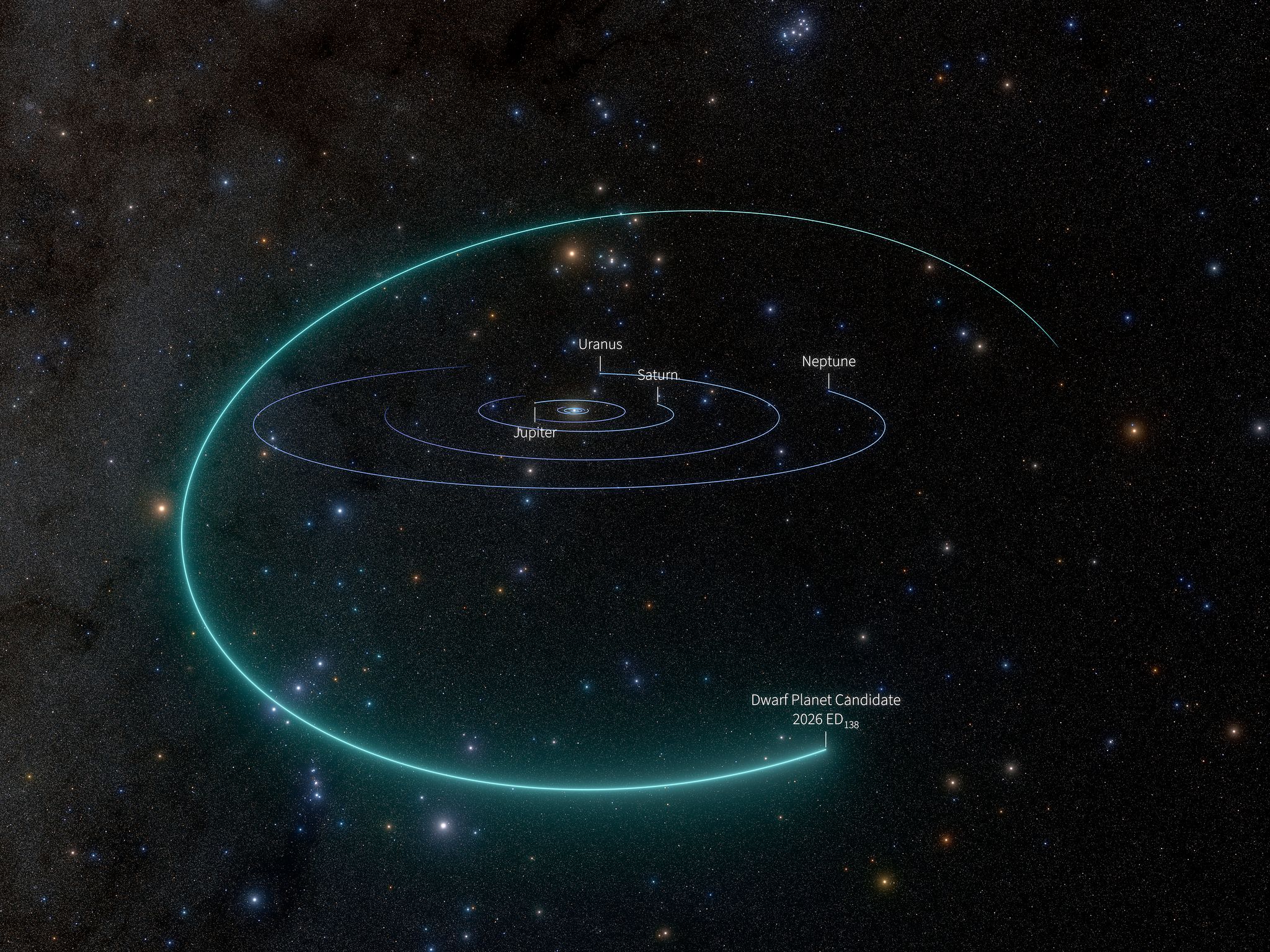
Jorge GarayScienceOct 29, 2026 5:00 AMAstronomers Discover a Possible New Dwarf Planet in Our Solar SystemLying beyond Pluto, 2026 ED138 could be as large as 1,500 kilometers in diameter. Astronomers are still working to confirm whether it meets the criteria for a dwarf planet.The orbital pathway of the potential dwarf planet sweeps far out beyond Neptune.Courtesy of Vera C. Rubin Observatory/NOIRLab/SLAC/AURASave StorySave this storySave StorySave this storyScientists are on the verge of confirming the discovery of another member of the solar system, a potential dwarf planet. Astronomers at the Vera C. Rubin Observatory in Chile located the object, provisionally named 2026 ED138.The prospective planet measures somewhere between 600 and 1,500 kilometers in diameter and is located about 46 astronomical units from the sun (an astronomical unit being Earth’s approximate distance from the sun). For comparison, Pluto—which is also now considered a dwarf planet—orbits at an average distance of 40 astronomical units. Based on its location, ED138 belongs to the population of trans-Neptunian objects. According to its discoverers, it could be one of the brightest known objects of this type and also among the largest.Like Pluto, the possible Dwarf planet’s orbit is tilted relative to the plane on which the planets orbit. The difference between a planet and a dwarf planet is largely their environment. While both orbit the sun and have sufficient gravity to assume a nearly spherical shape, a planet has cleared its orbit of other bodies of comparable size. Dwarf planets, on the other hand, coexist with other objects in the region of the solar system they traverse. This is the main reason why Pluto ceased to be considered a planet in 2006 and was reclassified as a dwarf planet.Matthew Holman, a researcher at the Harvard-Smithsonian Center for Astrophysics and a member of the observatory’s operations team, identified the object on October 13 while analyzing data collected by Rubin in 2026. A more thorough search allowed the team to locate additional observations in archived records dating back to 2016. Thanks to this set of images, the team was able to reconstruct more than a decade of the object’s trajectory.Astronomers explain that ED138 had managed to “hide” from us because its position in the night sky is against the disk of the Milky Way, which we usually see as a thick band of millions of stars. This concentrated brightness makes it difficult to distinguish fainter objects, but the Rubin Observatory’s enormous amounts of data made it possible to identify the object amid that sea of light.Though ED138 appears to have the right characteristics, astronomers have yet to confirm whether it is a dwarf planet. For now, astronomers know it is a trans-Neptunian object, but they need to determine its size more precisely to establish whether its own gravity is sufficient to give it a nearly spherical shape. If it meets the requirements, ED138 would join the group of five dwarf planets recognized by the International Astronomical Union: Ceres, Pluto, Haumea, Makemake, and Eris.It is also not the only celestial body awaiting possible classification as a dwarf planet. Astronomers have identified dozens of objects in the outer solar system that, based on their size and other characteristics, could meet the criteria. Among the best-known candidates are Gonggong, Quaoar, Sedna, and Orcus. Experts acknowledge that the list could be even longer.Confirming them as dwarf planets is no easy task. The enormous distance at which they lie makes it difficult to directly measure their size and mass and, above all, to determine whether their own gravity has given them a nearly spherical shape. To obtain high-resolution images of Pluto, for example, the New Horizons probe had to be sent to its vicinity—a journey that took nearly nine and a half years from its launch in 2006 to its flyby in 2015. Three years later, it reached the object Arrokoth, a small planetesimal even farther away.The solar system is often depicted as a star surrounded by eight planets, but in reality it is a much more extensive and populous structure. In addition to planets and moons, it contains dwarf planets, asteroids, comets, and a vast number of small bodies that extend far beyond Neptune. The Kuiper Belt extends to approximately 50 astronomical units, while the scattered disk reaches nearly 1,000. Much farther out lies the Oort Cloud, a region we have never directly observed and that could extend up to about 100,000 astronomical units from the sun.This story originally appeared on WIRED en Español and has been translated from Spanish.
By Katherine Langford
By Katherine Langford

By Katherine Langford

By Marcus Chen